Showing posts with label illustration. Show all posts

Monday, 24 February 2025

A Mammoth Night at the Museum


A Mammoth Night at the Museum


February the 14th - St Valentines days. Whilst other folks may be planning proposals of marriage, declarations of love, secret gestures of affection, or romantic rendezvous, a group of 150 people gathered to celebrate the love of all things paleo and mammoth, at the Corinium Museum in Cirencester.


The accumulation of hundreds of hours of digging on site at the Mammoth Graveyard in Cerney Wick, plus preparation and conservation, to get the finds ready to go on display. Just six months from mud to museum, and the grand opening of “Mammoths of the Museum’ exhibition was a joyous affair.

The exhibition, displaying items from the 2023 and primarily the 2024 dig, was passionately and carefully put together by Nev and Sally Hollingworth, who also arrange the opening night, with their usual flare.

The Rock Showman - Steve Cousins

 
It really is something to celebrate, often finds, go to museum and a few may go on display but many go into storage for study and research purposes, so getting to see the items volunteers have pulled from the reach on exhibition in one place it truly special.


The night was full of surprises too, we met and mingled in the beautiful cavernous meeting space at the front of the Corinium Museum, under the watchful gaze of Wallace and full-sized inflatable woolly mammoth courtesy of Dinomania. The evening was compèred with wit and energy by Rock Showman Steve Cousins, and had speeches from Sally and Nev and the landowners Hill Quarry products.


After an amazing announcement, the lights were turned off and the exhibition unveiled, viewed by candlelight (battery powered candlelight anyway) Neanderthal style, which was rather romantic and definitively a memorable way of viewing the exhibits. At the same time Wally the mammoth was unleashed, with his Dinomania Ranger as carperone/bodyguard.


Turning on of the light brought cake, (with some familiar cake toppers - my paleo mammoth on the big cakes!) 


Then The Pointy End, did a flint napping demonstration, whilst the Mammoth Trail was unveiled, with my mammoths in various historical dress, hidden around the museum.

The Pointy End 
 

Lastly, there was limited edition print sales of some of my mammoth and a hand axe by Tom Sermon of PaleoArt.com, with all money raised going back into the dig/conservation/exhibition fund, and a talk by Mark Baggott from The Herefordshire & Worcestershire Earth Heritage Trust - Fossil Box initiative that brings curriculum supportive fossil boxes into school.


the evening concluded with wine, and a visit to the neighbouring water hole.

It was an amazing event, and one that won’t be forgotten. Whet’s it they say? Mammoths never forget!


Sent from Outlook for iOS

Monday, 17 February 2025

Helping to bring Mammoths to the Museum

Helping to bring Mammoths to the Museum


If you’ve read my blog before you’ll know I’m mad about mammoths and that I had the privilege of attending the Palaeontology digs at Cerney Wick, the site that was found by Sally and Nev Hollingworth that featured on the BBC documentary Attenborough and the Mammoth Graveyard.

The site is an old quarry owned by The Hills Group, is an old estuary of the river Thames, and also encompasses a section of The Kellaway’s Formation so is a treasure trove of both Ice-age and Jurassic bounty. Since Sally and Nev discovered mammoth remains there is 2016, the site has had several digs. The one featured in the BBC documentary, and then two more arranged and managed with care and plenty of passion by Nev and Sally.


I was lucky enough to visit the 2023 dig on a sweltering August day, where I got to help plaster cast a tusk ready for transportation. In 2024 I attended for much more of the three week dig and loved all of it. From the shared adventure and comradery to the actual digging and being part of an important scientific endeavour and obviously seeing freshly found mammoths!

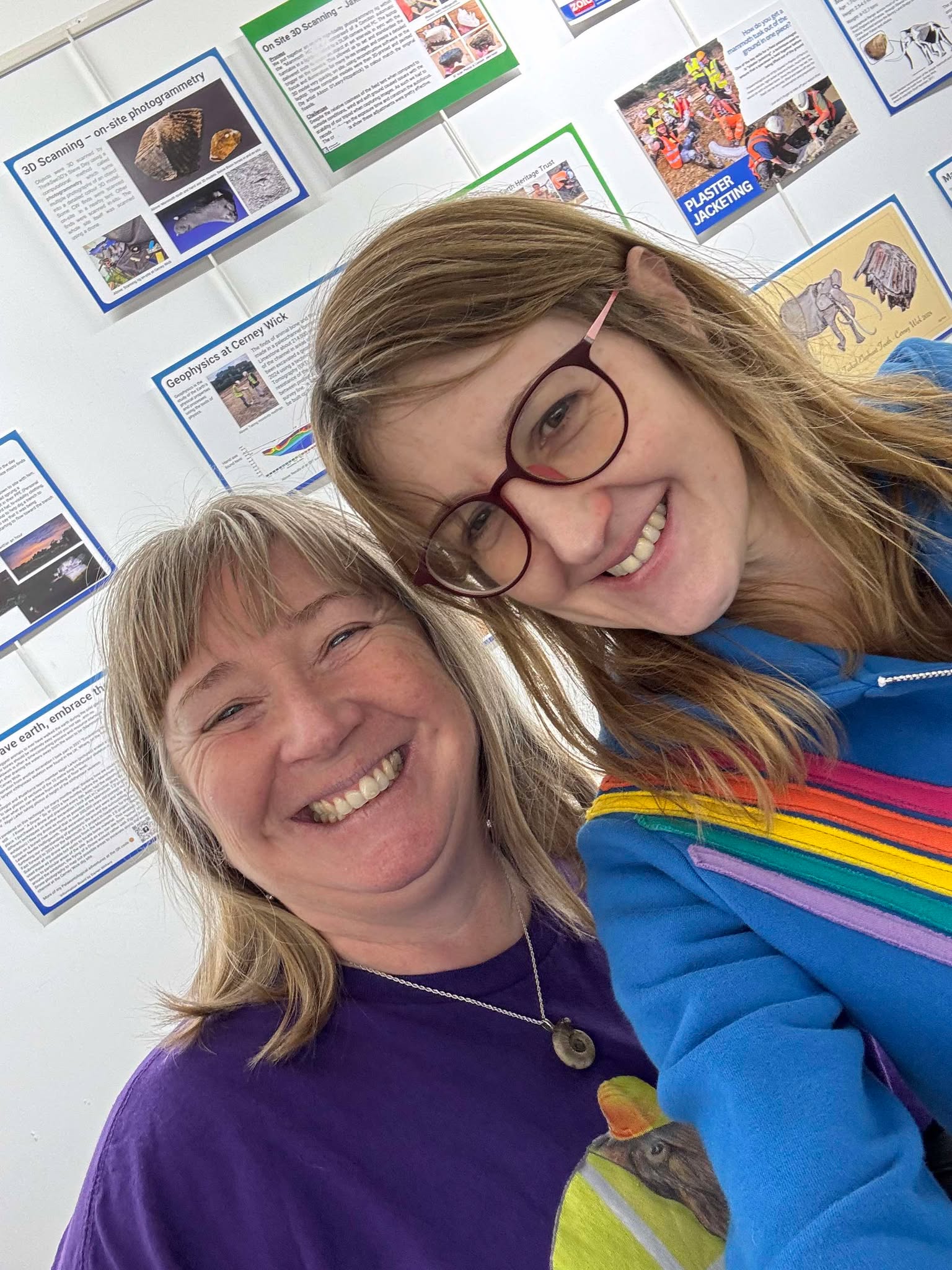
Nev and Sally being so dedicated and generous with their enthusiasm, knowledge and time decided to exhibit finds from the past two digs, at the charming Corinium Museum in nearby Cirencester. The exhibition opening in February 2025 – only six months after the dig.


So it was all hands-on deck – or in this case - fossil and bone, to help prepare and preserve the specimens! Plus find and fabricate suitable often bespoke hand made stands and cases, to both protect the finds, and display for people to view. Also Sally and Nev had the task of inspiring the army of nearly 300 #TuskForce volunteers from the dig, who now were back at work or university, to write, design and information boards for the exhibition. It was a mammoth endeavour!

For my part, I was excused from tasks in preparation and conservation, due to lack of skills. However I wanted to support the herculean effort as part of the #TuskForce team and contribute in any way that was useful.

So being a dab hand with a crayon, and being competent with illustration apps, plus coming from a children’s writers’ perspective, I created Top Trunks with facts about the Proboscidea species we’d found n site. I also made a comic explaining how coprolite is formed from poo to fossil.


I dipped out of my comfort zone too, to make a few more series paleo art illustrations.


But I really wanted to try and bring my experience and what I’d learnt from working in museums and bookshops, to the exhibitions. The first thing I did was compile a list of book recommendations for the souvenir shop, of recently themed appropriate books.


I also offered to do a quite/interactive corner, with bean bags, themed books and games. A place for a paleo-pause, or mammoth mediation. To engage people and give an added interactive element. With this is mind I sourced a mammoth print rug, bean bags and (along with Sally H) loads of paleo themed books and games.


Lastly I was delighted to have worked with the Corinium Museum’s staff, Caroline and Samatha – to create a series of illustrations for a mammoth trail, to accompany the exhibition. So I whipped out the crayons, and pondered what would a mammoth look like in Tudor attire, or in a toga? As the brief was to do mammoths that tied into the museum’s galleries. It was an absolute blast -barmy in all the best ways.


At last on one rainy Monday morning in February the mammoth task of assembling the exhibition began.


It was an amazing (exhausting) day, with seven members of the #Tuskforse team coming together under the guidance of Nev and Sally to curate literal truck loads of treasure.


In the morning when faced with four stark white walls and boxes of bones and fossils, it was a tad daunting, but with the Hollingworth’s signature enthusiasm and exhibition gradually took shape. The sheer scope of the task and the hours of effort put into the preparation is evident. It is an amazing (I know I’m bias) and excellent exhibition. It is well worth a visit during its month-long run. Plus is on during half term!


The exhibition runs from 15th February to 15th March 2025, visit here for more details.


Tuesday, 11 February 2025

Going out of your comfort zone

Going out of your comfort zone


Sometimes you need for the sake of sanity and progress to push yourself out of your comfort zone. It is easy to stay firmly where you feel safe, and my safe is writing books for children and doodling – mostly mammoths. But recently I’ve pushed myself out of the realms of comfortable – with a little nudge from another mammoth mad person who shares my first name – and into the world of paleo art.


This has in full disclosure included some of my more usual style illustrations of cute cuddly mammoths including making a Top Trunks display boards based on extinct Proboscidea, and comic strips on how poo fossilises and turns into coprolite. But also into something I haven’t done since studying fine art at university or perhaps my art foundation course, which is nearly three decades ago, creating accurate drawings. In this case studies of fossils and what the animals the fossils came from would have looked like when they were alive.


The work is considerably more intricate and time consuming, than crating cuddy mammoths, but it is as enjoyable as it is frustrating. I cracked out the good pencils rather than my usual wax crayons and got started. It was a learning curb. I found it easy to get so focused on the details, that I would forget to step back to ensure it was working as a whole, so I had to remind myself to do this at regular intervals.


I also felt mammoth amounts of imposter syndrome, with my brain constantly telling me that’ I am no good’. And that ‘I shouldn’t be doing it’. it got so bad that I ventured up into the attic and got down a framed print, that I had brought for my son when he was doing his GCSE art, saying ‘An expert in something was once a beginner,’ and put it beside me whilst I worked. It was to remind me that although I may have a degree in fine art, have been a professional artist, and have a lot of people who are very fond of my mammoths, I am only starting out as a paleo artist – and that I shouldn’t be too harsh on myself.


In general I think that the finished pieces vary in quality, but I am proud of them, especially some of the later ones which shows improvement especially considering I only embarked on this endeavour in August

So my point is that this has shown me just how important and healthy it is to explore places out of your comfort zone.


Saturday, 28 September 2024

A Summer of Mammoths – Part Two – Digging it!


A Summer of Mammoths – Part Two – Digging it!


#Tuskforce team of volunteers  


So freshly back from our grand Italian mammoth tour, and whilst battling with post-holiday laundry it was all out preparing for another adventure of mammoth proportions - the #TuskForce palaeontology dig, at the site found by Sally and Nev Hollingworth that featured on the BBC documentary – David Attenborough and the Mammoth Graveyard.

Two Sally's Sally Hollingworth and me. 


The dig was at the Hills Services quarry site in the Cotswolds who supported the endeavour in a myriad of ways. It spanned three weeks. It was completely funded by donations and completed by volunteers - over 180, from world expert palaeontologists, geologists, students, post-grads, fossil collectors, museum staff, entomologists and one slightly mammoth mad kids’ writer and illustrator. 

With Nev Hollingworth


It was an enormous endeavour, a labour of love of the aforementioned Sally and Nev Hollingworth, who organised the whole thing with tremendous care. They created a festival feel (many of the volunteers camped onsite), by providing evening entertainment - everything from educational talks to bingo nights, and ensuring and there were all essential provisions like - fresh water, toilets, assess to shower facilities, food, and most important a phone charging point! The Hollingsworth’s passion and bubbling enthusiasm was infectious and fostered a family feel across the #tuskforce team.

#Tuskforce team members including Andy and Vanessa who fed everyone!


I felt incredibly humbled to attend and initially felt a mammoth does of imposter syndrome (not being in any way knowledgeable in palaeontology) but was made to feel incredibly welcome and a valued part of the team. This was made clear by the fact that my mammoth illustrations were everywhere - the bins, the first aid station, the phone charging point, food tent and even the toilets! But also on people, I was delighted that one of my mammoths was chosen to adorn one of the official dig t-shirts, where part of the money from each sale went to boost the dig fund.


I spent 3 days at the dig on each of the first two weeks and 6 days on the final week. Being fair weathered and having dodgy hips, I stayed at air B&B’s rather than camping, but close enough to be the for the daily morning briefing. On the whole the weather was kind, a few wet days, a few sweltering. The dig was hum of shared adventure and passions and the exchange of knowledge. It yielded a wealth of new discoveries, both in the Jurassic and Pleistocene zones. Including a new addition to the proboscidean species of the site, a tooth from one of the largest mammals ever to walk the earth, a Stright Tusked Elephant, which was identified by visiting expert Professor Adrian Lister from the London Natural History Museum.


I really had an amazing time. I was let down a little by the limitations of my body, (dodgy hips, EDS, POTS) but when I couldn’t participate in the more physically demanding tasks like digging, I tried to make myself useful. This was assisting in the less glamorous but essential jobs, like assisting the awesome Andy Lee with the water run to get fresh water every day. Trips to the supermarket, helping prep meals, even sorting out the portaloos. 

sneaky coffee with the lovely Andy Lee 


But I also drew specimens, on site (with a very crude art kit consisting of crayons and felt tips), photographing and videoing the dig, and conservation tasks and talking to other volunteers, learning about the diverse journeys to being involved at the dig.

Drawing a mammoth tooth on site.
 

It was a real privilege to have had such an amazing experience, and I extend a massive mammoth thank you to all of the #TuskForce team for making me so welcome, to Hills for supporting the scientific endeavours on their land, and to Sally and Nev Hollingworth for their dedication and generosity in arranging the dig. I am so happy to have been a small part of it!

With a mammoth rib.


Wednesday, 1 November 2023

My First Mammoth Event!


The first time I started writing about mammoths was in 2008, it was a not very well conceived picture book. Fast forward a decade to 2018, and whilst attending a writing for children course at the Oxford University Centre for Continued Learning, I began writing a middle grade story about a Neanderthal and a mammoth. This also went on to a draw of partly planned rough drafts alongside my first mammoth manuscript.

Then in 2020, whilst researching de-extinction for a YA Neanderthal thriller, I read a book on the science of bring back long dead species called ‘How to Clone a Mammoth’ by Beth Shapiro. Despite being about bringing back many long dead faunas I got a bit distracted by mammoths. I think it was the plan for mammoths to help in the battle against global warming, and that there is already a home waiting for them, Pleistocene Park in Siberia, which really caught my imagination.


A few nights later I dreamt a scene (corny but it’s true) about three children studying ins a remote artic region, when the building begins to shake as a massive herd of mammoth amble into view. This became the starting point for my work in progress. In 2021 when I first succumbed to the dreaded covid, while in isolation I began drawing mammoths, and an obsession was well and truly born.


I am currently doing an edit on the book and hope to be out on submission soon. But at the same time, I have building up a portfolio of mammoth illustrations, and making friends with other mammoth enthusiasts.  This led to me being asked to participate in a local town’s Jurassic Festival – YES, I KNOW MAMMOTHS AREN’T FROM THE JURRASSIC PERIOD! But it is prehistoric!


So, with just a over a week to prepare, and shoestring budget I set to work.  I stated with a display. It had to engage every age group from toddler to the elderly, and not cost too much. Luckily, I managed to pick up a free exhibition display board from a marketplace social media site. I used the boards to display information about general mammoth facts, mammoth cloning, and the theories of their proposed benefits to helping with the battle against global warming.


Then about palaeontology and bit about one of the most exciting recently discovered mammoth sites, The Mammoth Graveyard as featured in the BBC David Attenborough, that was found by Sally and Nev Hollingworth near Swindon. 

Lastly, I displayed some of my mammoth illustrations.


I desperately wanted people to interact and chat and ask questions. So, I designed some craft sheets for children, design your own mammoth – cold proofing an Asian elephant, 3D mammoths and mammoth colouring.  I also created some takeaway sheets, with information of local mammoth places to visit, free mammoth documentaries to stream and recommended mammoth reading for all ages.


On the day I managed to squeeze into my mammoth skirt and set off. I set up the boards, crafts and also displayed various mammoth fossils, bones, and models for people to see and touch.

I felt nervous, but I shouldn’t have worried, as people were interested. Over the course of the hour and a half I spoke to as many adults as children with an age spread of toddler up to approximately mid-eighties. The conversations varied depending on who I was chatting too, with a lot of the adults being intrigued by the cloning and asking more questions about global warming and how cloning could be used in a broader sense to help endangered animals, to children asking about mammoth / human cohabitation. At one point I was even discussing the death of the last known living dodo and the chances of bringing the species back from extinction! Both adults and children alike were fascinated by the mammoth bones and fossils, the baby mammoth tooth causing quite a lot of excitement.


I was pleased to see few children (and a few adults) pick up the activities, especially the ‘design your own mammoth’ task, and I took time to engage with them and tell them how the chosen dress-up items for the elephants reflected how mammoths had evolved to adapt to survive in cold regions. A lot of children took the sheets home to share with siblings. Quiet a few people wanted to learn more so took the handouts about local mammoth places to visit and free documentaries to stream and/or took the handout of recommended mammoth books to read.


All in all I think it went well. I was delighted to share my love for mammoth with other people.


Tuesday, 24 May 2022

Out of the mouth’s of babes… confidence boosts from unlikely places


Being a pre-published writer is a rollercoaster of emotions. From the highs fuelled by confidence boosting short-listings or full manuscript requests to the deep dive into depression caused by imposter syndrome and rejection. Sometimes the pursuit of publication grinds you down and you doubt your ability, and wonder if you have anything to give or say that readers will find interesting. This can be difficult to circumnavigate.

For a while I’ve bumped between these two emotions, like a jack in the box. However I’ve had a few encounters that have reinforced my confidence and convinced me that my books do have something that would appeal to children.


Recently I’ve re-embraced by first passion for illustration, *read about it here* as a consequence I’m setting up an Etsy shop and am running a pop-up shop selling my work. This is the unlikely setting where these encounters took place as I had the pleasure of meeting some incredible children. The children in question were intrigued by my mammoths and we struck up conversations.

One 10 year old, dyslexic boy was fascinated by mammoths, and by my illustrations. I showed him how to draw mammoths and told him about the science that has inspired my latest WIP. His mother has since contacted me to let me know that he (two months later) is still drawing mammoths, telling everyone about mammoths and enquiring about when my book will be published! Editors and agents feel free to contact me!


Look at these AMAZING drawings by the 10 year old I mentioned.


Another 12 year old with dyslexia and dyscalculia was equally enthralled by mammoths and with my illustrations, we made a pact that next time he comes in I’ll teach him how to draw them, and he’ll show me how he draws goats!


Another younger boy or 8 or 9, was conversing with me and when I mentioned the ‘Mammoth Rival Project’ and the idea that cloned mammoths could help with the battle against global warming, he got very excited and begun explaining back to me how scientists were looking for mammoth genomes in order to edit elephant DNA ! His mother’s face and amazing, she had no idea how passionate he was about genetics. He was therefore very taken with the concept of my novel.

Amazingly most of the children I’ve spoken to are dyslexic and many have dyscalculia also, and all were very keen to read an own-voice book with a protagonist like them, just like mine!

It bring me joy to know I’ve inspired them in some small way, and they have given me the affirmation I need needed to continue in the relentless endeavour of submissions.


Submissions here I come!