Showing posts with label Dyslexia. Show all posts

Sunday, 3 March 2024

Dyscalculia Awareness Day - Daily life with Dyscalculia


Today March the 3rs is Dyscalculia Awareness Day. What (You may ask) is Dyscalculia? As most people indeed need to ask, and therefore this day is much needed. Dyscalculia is one of the neurodiverse diagnoses which is specific to people who have difficulty identifying, reading, sequencing, and understanding numbers, values, and mathematical processes. It is akin to dyslexia but with numbers. However, unlike dyslexia, which many people at least have heard of, but may not actually fully comprehend, dyscalculia is less well known. I have even spoke to teachers who don’t understand what it is and aren’t even aware of its existence. It is a bit rarer than dyslexia, which affects 9-12% of the global population, Dyspraxia is up to 6%. However up to 40% of people with dyslexia also have dyscalculia. I am one of the 40%.

I wasn’t diagnosed with dyscalculia until aged 19, the same time I officially got diagnosed with dyslexia, however every teacher knew I had dyslexia as it was better known and understood, so individual teachers gave me extra support, and because I wasn’t officially diagnosed many of them wrote to the exam boards asking for me to get extra time, which I indeed received due to barrage of letters and evidence that each teacher individually sent them – for which I will forever be grateful. Despite this is still struggled a I was still on first readers ‘Billy Red Hat’ type book when I went up to secondary school, but at least it got recognised and I received helped.

Math on the other hand was a different matter. I couldn’t learn my times table and frustration as to why, came out in discipline from my parents and epic temper tantrums and fits of violent outbursts from me, coining me the title problem child’. Learning math was incredibly difficult as numbers didn’t move on the page (as poetic descriptions) but every time I looked down from textbook to exercise book or board to paper, the numbers were in a different order. I can tell you getting the correct answer for a sum, when the number keep changing if very difficult and frustrating. Plus, I never got any help. No one in school had any idea about dyscalculia, not the math teachers, not Learning Support, not even the educational psychologist. I just got labelled lazy which added to the frustration as I was working so hard to try and master it.


But challenges were not excusive to math, one of the biggest and still most difficult tasks is reading clocks analogue or a digital. Trying to work out the time when numbers are creating havoc is impossible. And a 24-hour digital is no better, you can’t image how many times I have turned up to an appointment at the wrong time as I have misunderstood the time. either too early or too late. This also extends to dates. In my early twenties I turned up to a job interview on the wrong day as I miss read the date. They were surprised when I arrived and quipped I was early, explained how much early and proceeded to interview me. The first question; ‘what is you attention to detail like’. I didn’t get the job.

Then there are phones, do you remember back in the 80s and 90s, when phones were attached to a wall, and you had to dial the number? Well, I do, and it is a horrific memory. I could dial the same number incorrectly serval times, resulting in an embarrassing exchange with the person I had disturbed on the other side. Resulting in epic meltdowns. As an adult the phone issue persists but know there is the technology to have all your number stored on your phone, and most numbers you can dial straight from the web on your mobile, which is much easier. But I still hate phoning people due to all the childhood trauma and avoid it where possible.


Technology may help on some ways, like the phone, but with others it is getting increasingly difficult to navigate. This is because of digitalisation and the ever-growing reliance on pin codes both pure numerical and also letter and numbers (remember dyslexic too). I often can’t use my debit cards as I can’t get the four number correct. I once had a house with a pin-lock rather than a key, I spent hours locked out waiting for my husband to come home. So I come back to the tool that helps, by phone, as I note my pin code on there.

Then there was France. A holiday with a friend and her son and mine. Which was lovely until, I had my phone stolen. Before you ask, no I don’t speak French. It was tricky enough mastering English (dyslexia). So I am stuck in a foreign country where I don’t speak the language and I can’t use my debit cards because I can’t get the number right. It was isolating, embarrassing and far from relaxing.

But by far the biggest obstacle is that people are not aware of it, or its impact, and treat you as if you are deficient on the intelligence front. This is why the protagonist in my latest novel ‘Ashley Grimes Mammoth Whisperer’ has both dyslexia and dyscalculia.

A few years ago, the BBC news ran an article about a professional dancer who has severe dyscalculia, I posted it everywhere, and many adults replied who also have it. They were all very interested to hear that I was writing a children’s book with the main protagonist that has dyscalculia. All of them wishing they could have a read a book as a child with someone like them reflected, so they knew they would have known they weren’t alone. So, I have worked really hard o make my own voice depiction as accurate authentic and positive as possible and am now embarking on submitting hoping it will find a home and maybe provide the sort of reading experience for children with dyscalculia that me and other people would have loved to have had as children. An acknowledgement and knowing they are not the only ones.

Wednesday, 24 August 2022

Neuro Diversity, The Preverbal Swan, and the Humble Mobile Phone

A few years ago, when I was working front of house at a museum, I attended a course on Deaf Awareness. The course was run a lovely man who was profoundly deaf. It was very illuminating, as there were so many things that caused deaf people issues that seemed so obviously but that we’d hearing people had never thought of. At one point he explained how mobile phones had revolutionised communication of the deaf community. This caused some stifled giggles from some of the older attendees, largely those that can recall the ‘Not the Nine O’Clock News’, Rowan Atkinson, Deaf Telephone News Skit – (it you know you know – and like me you’re old!) Thankfully the course leader laughed too, and said he’d had the exact same response when a deaf friend advised him to get mobile phone. However, it was not the ability to make calls on the go – but the innovation of text messages that had the positive impact. And of course this was greatly improved with the advent of smart phones and video calling meaning it’s possible to have conversations in sign language that has had the positive impact.


Now I am not profoundly deaf (I am a little bit deaf) but I’d never compare myself to that or my Neuro Diverse issues with what the deaf community faces, but there are some similarities. For example how the mobile phone can help neuro diverse people navigate the modern world, and how many neuro-typical people are largely oblivious to their difficulties.

I have dyslexia and dyscalculia. Most people have some idea of what dyslexia is, but few people have heard about dyscalculia or know that it affects your ability to process and understand numbers. Living with dyslexia and dyscalculia is a challenge in a world that is increasingly reliant on password, passcodes and pins numbers. Many of which are a sequence of letters, or letters and numbers.


Having Dyslexia I have a dreadful short term memory. I can remember exactly three telephone numbers

  • My mobile phone number – but only if I recite in a particular rhyme.
  • My childhood telephone number - as it was the same for twenty years, but due to relocation is no longer belonging to anyone I know.
  • My parent’s landline, which they had for over nineteen years. However they disconnected it a few weeks ago.


*I also do not know any pin number/passcodes. And if I do I can’t input them correctly.


So I rely on my digital Swiss Army Knife (to quote someone much cleverer than me), and use my mobile as a database. I save my codes and passwords on it, so I can easily find them or even copy and paste them. This is fine until something happens to your phone.

Recently I was on holiday in France, with my son, and my friend and her son – and I lost my phone. I was stuck in foreign country where I didn’t speak the language, I couldn’t contact anyone as I don’t know any telephone numbers, and I can’t get any money out or pay for anything by card if a pin is required. Essentially I couldn’t function. This didn’t make for a relaxing holiday at all.

The reason I’m writing this post is that many people didn’t grasp the impact of not having a phone had on me, and seemed to think I was overreacting. I had a lot of well-meaning comments like…

“it’s annoying but… it’s only stuff, it can be replaced.”


People don’t see. It’s not a mere inconvenience, it takes away my ability to be independent and participate in modern life. It’s like taking away someone’s glasses.

Having penned this blog on holiday. I was umming and erring about posting this blog. However earlier today another ND friend broke her phone and going through a similar ordeal. So I decided to be brave and put this post up. To highlight, that although neuro diverse people are articulate, intelligent and together people many of our struggles go unnoticed, like the preverbal swan, its invisible – nothing to see on the surface, and yet we have many many coping mechanisms set up so we can function. And so a broken or lost mobile phone may indeed be a whole lot more than an inconvenience.


Monday, 19 July 2021

Maptastic World Building.


I love a good map. The first map I ever saw in a book, was Tolkien’s map of Middle Earth in The Hobbit, when my mother red it to us when I was a child. I loved the map, and would study it for hours. You see I couldn’t re-read the book myself due to my low-reading age due to my undiagnosed dyslexia, BUT I could stare at the map and imagine myself going on the journey and experiencing Bilbo’s adventures. It was a visual tool that allowed me entrance back into the story.


The next map I saw was when I was in my mid-teens was of One Hundred Acre Wood by E.H. Shepard. I loved it for its intricacy and pen-man ship, but it was a bit of a shock, as I already had seen it in bright Disney animation, with Poo jumping between the pages, the original is however much more intriguing and inviting, which is probably why the original fetched £430,000 at auction in 2018!

When I was at school I was good at both geography and art (both of which I went on to study at degree) so of course everyone put two and two together and thought I should pursue a career in cartography of course none one took into account my bad sense of direction, or the fact I didn’t know (and still don’t) my left from my right. However how that I’m writing and world building, I find map-making hugely helpful.

‘I wisely started with a map and made the story fit,’


J. R. R. Tolkien, 1954


Unlike the very wise Mr Tolkien, I usually start with a story, then when it all starts to get complicated, I put pen to paper and draw a map, (and characters and landscapes). But the map is probably the most helpful, and the only thing you can’t get anywhere else, unlike characters, where you can get photographs from the internet (or like Roald Dahl did, keep a stock of photos cut out from magazines and newspapers.)


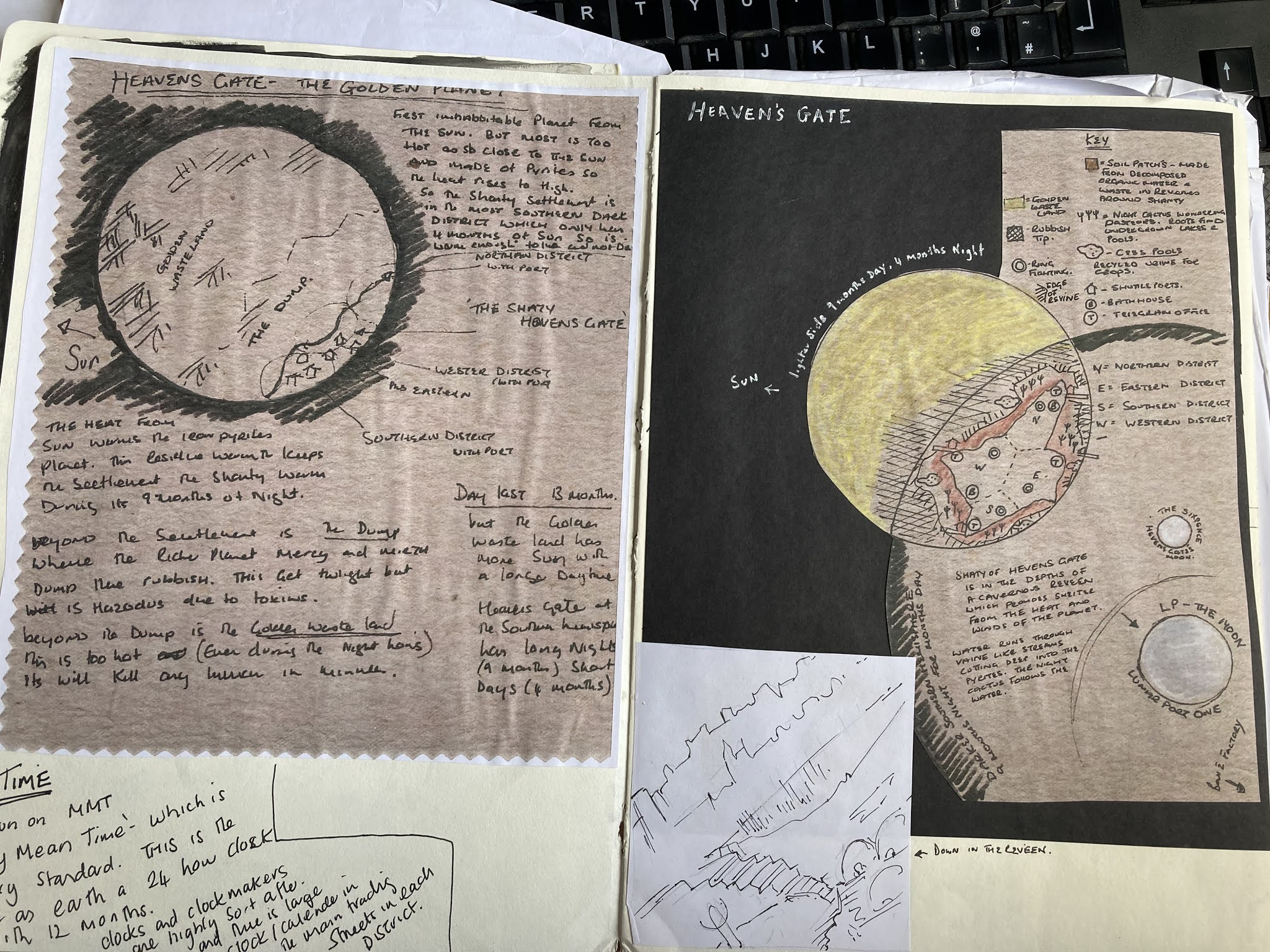
I have tried my hand at cartography for a few of my books, one a sci-fi fantasy YA, it was more of a drawing of planets and more recently I have tried my hand at a more traditional map for my WIP mammoth book, of both the geographical area and the main complex. It is so helpful to actually see where everything is in realisation to each other, and for unlocking key aspects of plot. Of course some writers like Terry Pratchett can keep it all in their heads, and never make a mistake, but for me I need to see it to really write it.


One thing I have discovered is that although I’m an artist by training (one thing I can do is draw!) Sadly my maps aren’t spectacular. In comparison however my 15 year old son, is a very talented map-maker. He had previously been commissioned to draw maps for peoples Dungeons and Dragons quests, and his world building is fantastic. He starts with maps, and then works on the biomes, eco-systems, faunas, flora, cultures, histories, cuisine, fashion, languages and mythologies. All these things are rooted and inspired by the original map and type of biome he’s created. I am in no way envious of his commitment or talent honest!

My son's world building & Map making


In fact I think maps are an essential part of world building – just as much as mind-maps as an essential part of plotting. Like Tolkien’s map of Bilbo journey ‘there and back again’ in The Hobbit helped me enter Middle Earth, creating map helps me enter the world and experience it, and even envision the environment , making it easier to describe but crucially see how the biome will influence the plot .


So if you haven’t tried drawing a map yet, I totally encourage you to do so, it really doesn’t matter about how well you draw (after all Tolkien wasn’t a great artist and his maps are possibly the most famous in fiction!) If you need any more encouragement I suggest you have a look at the beautiful celebration of fictional maps, in the lovely book The Writers Map edited by Huw Lewis-Jones, that explores fictional maps, and how to create them.


Thursday, 15 July 2021

The Rubber Ball of Doubt


This week I had a serious dose of the Doubts. It’s a feeling I and many writers (especially pre-published) know well, as it happens again and again. In my mind doubt is made of rubber and like the song says, ‘Rubber ball keeps on bouncing back to me.’

One day I’m full of confidence, sure that I’m a good writer, convinced that my latest WIP has commercial appeal, a unique concept and a strong voice and plot. Optimistic that if I keep honing my craft and keep submitting that one day it’ll happen, I’ll get picked up and get my book in print.


The next day I’m anxious and depressed mess as doubt crashes my positive party. Suddenly it’s, ‘My writing isn’t good enough.’ ‘My writing will never be good enough.’ ‘My extra issues that my dyslexia pose are getting worse raising the hurdles higher and unsurmountable.’ The universe and time are conspiring to make sure that my dream of becoming a published author is never happens’.

So why is it that one day I’m so optimistic and the next I’m full of pessimism? 

It only takes one thing, like a…

  • A rejection that I’ve not indigested the feedback. (Once I read the comments and understand them, usually I can throw thee rubber ball away again.)

  • A long-list missed.

  • A spelling or grammar mistakes which I have found after I have pressed send on the submission.


So why does it get me so down with doubt?


  • All the voices of all the people that have told me am not allowed to write because of my dyslexia comes flooding back into my write telling me ‘ I can’t write.’ Then all the other voices telling me what I can’t do because of my dyslexia join the party too.

  • Knowing that NO MATTER HOW HARD I TRY, my spelling isn’t getting better, and I will never be able to get my manuscript void of all dyslexia-isums. And despite being far away from the bread line that I can’t afford to get every submission copyedited.

  • The niggling worry that despite the current move of inclusivity within the industry for diverse authors, including neuro-diverse writers, that although there are other dyslexic writers that are successfully published, that my dyslexia is pretty bad and maybe I’m just too far up the spectrum to get published.


So when all these doubts pile up, I have to pull myself up. I look at things logically, and see that the facts haven’t changed. I’ve have still had competition long-listings, short-listings and wins, which seems to confirm I’m not totally bad at writing. I still get more bespoke responses from submission that standard ones. I’m still working and improving my craft. I’m still dyslexic, but the industry is make positive steps to try and make it easier for people like me to get published.


So why when I tell myself all of these things and throw that ball of doubt away, does it always come bouncing back with more velocity?


I don’t know why the rubber ball of doubt seems to hit harder each time, but I do know this; The children’s writing & illustrating community is so supportive of each other, that when I get too tried to throw that rubber ball away, someone, will say, ‘hay, take a break,’ and they throw the ball away for me instead.

So sometimes I get down, but I love writing, and I’m surrounded by wonderful supportive people, and we all help one another when that ball of doubt land in our court. So writing onwards I go…


Tuesday, 6 July 2021

Clearing the Cotton Wool (in a vain hope to boost my creativity)


Lately I’ve been struggling to get my brain in gear and enable me to be productive. I can’t seem to stick to task, or achieve the momentum of creative flow, even decide on a course of action or remember anything. Many of you will know the feeling - the feeling that your brain is clogged up with cotton wool.

This is me presently – struggling with cotton wool brain and it is SOOOOOOO frustrating. The issue is made worse as my POTS (Postal Tachycardia Syndrome) making me tired, light headed, giving tummy issues and BRAIN FOG (which is another way of describing Cotton Wool Brain.) Add to this my dyslexia, causing me difficulties with my short term memory and concentration it all adds up to one thing, a bad case of cotton wool brain and reduced creativity.

This results in my confidence taking a hit which causes my mood to plunge which means I get anxious about not being creative enough. This then makes me doubt my ability to write and to navigate around the substantial extra hurdles my health issues and neuro diversity place on the path to publication. All of this of course makes my cotton wool brain to get worse.

So How to Clear the Cotton Wool from my Brain?


  • Exercise is one of the best ways to relive POTS related symptoms including brain fog. However POTS also makes me medically exercise intolerant as my heart is already strained by just keeping me upright. Add to this my dodgy hips making most exercise impossible, and hyper flexibility which mean I can and have broken bones and dislocated joints my standing still - let alone moving or exercising. This makes exercise a challenge. Despite all the challenges my health issue present on my ability to exercise, I do walk everyday - as long as it’s on flat ground and good terrain. Of course some days it my hips are bad I can’t walk at all.


  • Lists and Post-its. I have to-do lists and post-its everywhere. this is to try and focus my brain on the most important tasks and to combat my bad short term memory - to try and reduce the possibility of me forgetting anything.


  • Eating better. Eating better, can help ease my POTS symptoms including the cotton wool brain. This of course takes time to plan and prepare, but the benefits are worth it. Just look at Deliciously Ella, who had really debilitating POTS which she managed through diet.


  • Better Sleep. This is obvious, but when I have a bad case of cotton wool brain, it usually comes with a bad bout of POTS and hyper flexibility - which means more pain. Joints, Hips, and a bad tummy which makes sleeping difficult. Also due to my hyper flexibility I can’t take any sleeping aids, as these relax the muscles, and if I do, I can’t walk in the morning. So this is difficult, and any tip gratefully received.


  • Getting Out. Sometimes the best was to clear the cotton wool is to force its out. If I change the environment, by going anywhere that isn’t home, there are fewer distractions. This means if I take a note pad and pen, and put that pen to the paper, I actually write. It may be BAD writing, but l think of it like panning for gold; you have to work through a lot of dirt to get the nougat. This forces the rain to cast aside the cotton wool enough to stick to task. Even if the output isn’t the best quality, it is a start and the next time I try and write it is easier.


All in all cotton wool brain is frustrating. Sometimes it is a massive challenge to clear it all. But then I’m a dyslexic trying to make a career in writing, so challenge is something I rise too – although slightly slowly and wobbly , I do rise.


Wednesday, 8 July 2020

Debunking Dyslexia Myths


Recently when discussing with other writers about the difficulties of pursuit of publication, and me mentioning my dyslexia, as being an additional barrier I have been told, ‘but that’s what spellcheck is for’, like it is a magic cure. This is just one myth about dyslexia, that really is exactly that- a myth. Just as a wheelchair isn’t a cure for someone who can’t walk, spellcheck isn’t a cure for dyslexia. So I thought I’d do a little dyslexia myth busting post.

Myth One – Spellcheck cures all Dyslexia Ills….


Gosh I so wish this was true. I know a lot of people believe it to be true. But spell check is just a tool, one that can help minimise dyslexia associated spelling and grammar issues, but it can also be as much as a hindrance as a help.

Spellcheck gets it wrong!


Spellcheck often helpfully corrects my spelling as I type. Oh this would be great, I mean properly great if it worked. But unfortunately my spelling is so bad, that I’m often nowhere near what the correct spelling should be and so Spellcheck picks a totally wrong word to replace it with. This is bad because the wrong word is correctly spelt – BUT IT IS THE WRONG WORD. Why, you may ask is this a problem? Well, as it is now no-longer a miss-spelt word, it no longer has a red-squiggly line underneath – so I can’t tell it’s a wrong word and find out the correct spelling to put it right. This means that I sometimes have some hilarious incorrect but correctly spelt words in my manuscript like…


Also, to further illustrate my point, here’s a poem by Norman Vandal which demonstrates my point much better than I can ever do...


Spellcheck is a Diva!

Oh yes, Spellcheck is the equivalent of a diva movie star who, if thing aren’t going their way, storms off set to their trailer and refuses to work. Seriously it is true. I once was 20,000 words through a 80,000 word manuscript when this a message came up from spellcheck saying that due to there being too many mistakes, it was turning its self-off. But unfortunately I didn’t realise that this wasn’t just an idol threat. And it did – it had a diva strop and stopped working. Resulting in the first 20k of my MS being readable and the other 60K being in such a dyslexic redden form of English no one could read it. I actually thought this was a phenomenon unique to me, but recently another published best-selling author tweeted the same error message. Which I have to say meant I felt better - but further demonstrates my point, that Spellcheck is a diva.


And don’t get me started on Autocorrect!


Myth Two - There a loads of Dyslexic Children’s Authors 

Loads of people tell me this and they can then probably name two – three at most. According to the British Dyslexia Association 10% of the British population is dyslexic. And according to world statics is more like 16% globally. Dyslexia doesn’t discriminate – that is 10-16% of the world wide population no matter of class, culture or colour. So I have created a list of dyslexic published children’s authors on twitter and I have 6 members – six authors out of the hundreds of the published authors that I know personally or follow on twitter and Facebook – only 6 of them I know to be dyslexic. I’m sure there are more, but I am pretty sure that it is nowhere near 10 -16% of all the published authors working currently.


Myth Three Dyslexia  isn’t Barrier to Publication


'...and about the spelling and grammar...'


Every piece of feedback I have from critique groups to from editors and agents – ALWAYS mentions my dyslexic issues. Sometimes everything is really positive BUT the Spelling and Grammar – and it is really difficult to not wonder if that is the reason why the answer isn’t a yes.

Earlier on in the year I entered a competition, which was judged by a panel of four judges. All four liked my manuscript and said yes to giving it a place it on the longlist. In fact it was actually one of the judge’s favourite submissions. However one of the adult judges said a load of glowing positive AS GOOD AS IT GETS feedback. But then was unprofessional and scathing about my spelling and grammar. And so when I didn’t make the long-list it is difficult to not think that I was marked down on the point system for my spelling. 

This is made particularly painful as the competition especially asked – in a whole tick-box special section –if you have any disabilities and I said yes and explained about my severe dyslexia, dyspraxia and dyscalculia. So if you are going to actually promote yourself as a competition that encourages neuro-diverse authors to submit, then maybe you should consider not being –  really unpleasant about their issues in feedback and also, not mark them down for their issues.

Don't forget the Cover Letter

Of course you may get your MS as dyslexia free as humanly (well - non-professionally copy edited) possible. But then there is the COVER LETTER. Oh yes, I get people to check that too, but then that just the generic copy. I then personalise it or adapt it for every submission. There is only so much goodwill or time others can devote to correcting my spelling. I can’t tell you how many times I have checked-re-checked- and recheck my over letter before hitting send – only to find an error I hadn’t spotted after it’s gone.


Myth Four – It’s Easy to get your Dyslexia-isums removed from your Manuscript


Getting rid of the  Dyslexia-isums

I try really hard to eliminate all my Dyslexia-isums by…
  1. Utilising Spell Check -[ Insert laughter here ]
  2. Reading through and marking anything I can spot up on a print out and then correcting in the document. – ALTHOUGH – my tracking when reading is poor – due to dyslexia – and tracking from one document to another is even worse, so often when correcting mistakes, I make more. 
  3. My husband reads through everything I write and dose a copy edit –correcting my wobbly spelling and haphazard grammar.
  4. My lovely critique group buddies, correct my spelling and grammar on my submission which I then input into the document – but with my tracking issues I often as said before input shiny new errors!
  5. I am lucky to have some lovely friends who do a beat reads – who correct my issues as they read. 

And after all that I still have spelling issues in the manuscript

Just pay a copy-editor

I write YA – that between 50 -80 THOUSAND WORDS. You have a look at the cost of a copy-editor of a book that size, and I’ll let you work out the barrier!


Myth Five- If you Read you’ll be good at Spelling and Grammar


Oh you would think so right? But NOPE.

Dyslexia is an issue with the way the brain processes information – also sometimes it can be about how the eye work too. The issue is that you can read loads, but as what you see or what your brain processes isn’t the correct spelling (or even grammar as you can change where all the punctuation marks and stuff goes), so you don’t build up a database in your mind of spellings – and if you did that’d probably be spelt wrong.

Ok you are right dyslexia doesn’t officially affect grammar – but if at school in say year 9 and you’re still on Biff and Chip books, or in my case Roger Red Hat and Ladybird Peter and Jane books, you kind of miss out on all of the grammar lessons.

Oh but you can just learn grammar now – believe me I’m trying and I’m infinitely better at it that I was – but I’m learning form feedback form my critique group and after a timely lesson form my friend, neighbour who happened to be an editor – thanks Lou John. But I keep looking for an adult’s dyslexia friendly grammar course and can’t find anything suitable. Plus of course there’s the ££££ issue again.

Myth Six- Dyslexia ONLY affects your writing and reading it doesn’t impact everyday life


Ok, again – I so wish this were true. And actually I’m going to cheat it a bit here as I’m going to include my other Dys’s - dyspraxia and dyscalculia.

  • EVERYDAY - I walk into doors as I read the ‘PUSH’ signs on the other side of glass doors as if it’s on this side.
  • I often go out with my clothes on back to front/inside out or buttoned up wrong. All I can say is that I’m very glad I no longer have to worry about wearing a tie - the knot in my school one lasted 5 years.
  • I also have dyscalculia – DYSLEXIA WITH NUMBERS – oh yes; I can’t dial a phone number as I get it wrong multiple times. And don’t get me started on credit/debit card PIN codes – nightmare.
  • I have a dreadful short term memory – I often ask my husband if he wants a cup of tea multiple times in ten minutes and forget the answer or just forget to make it. 
  • I am SOOO clumsy – I fall down stairs – I fall up stairs - I even fall over thin air. I walk into things. I bump my head. I’m really an accident looking for something to happen. 
  • I say words wrong all the time. Why – because I have learnt them by reading them – and my brain doesn’t always see them the way they are - (the whole letters moving thing) – so I pronounce them wrong. Like Neapolitan Ice cream - that I thought was Napoleon – which caused quite a bit of embarrassment when I asked a guest if they wanted some Napoleon ice-cream with their desert (aged 31!) 


So the myth busting is over (promise), and I would like to quickly say, that this isn’t a whinging post but one to highlight some of the extra hurdles that people with dyslexia face when writing with the dream of publication. I am constantly looking for new ways, tools and coping mechanism trying to minimise the impact of my dyslexia on my writing, but it tends to have a time and cost impact, which add yet another hurdle – one that many other dyslexic writers can’t circumnavigate. One of my dreams - other than getting published and the book selling of course - is that if/when that happens, I will endeavour to set up a competition or fund for dyslexic authors where the prize is for their submission package to be professionally copy-sited – to increase their chance of not- being dismissed on the slushpile.

Lastly if you are an editor or agent reading this -PLEASE PLEASE PLEASE don’t let this scare you away.


Friday, 24 January 2014

Never Judge a Book by it's Movie? But Trust the Movie to Help Kid's Stretch their Reading Abilities to Read the Book!

I'm really pleased to see the news article this week about the impact of movie adaptations of books on children reading. Using my best finely honed craft, revered usually for one line pitches, I’ll give you the summery; that watching movie adaptations of books, inspires children to read books above their reading age thereby challenging, improving and expanding their reading abilities. To read the full article press here.

I personally welcome the research, as there is always an argument that movies and television are some way in conflict with reading which I stringently disagree with. You see as any of you who have read my blog before will know I’m dyslexic.

My dyslexia was horrendous as a child, and reading was a hard heart breaking and potentially volatile endeavour, and reading despite me LOVING it (and hating it in equal measure) took a great deal of commitment and investment. I read slowly, one word at a time, and usually ended up in an emotional mess because I couldn't read the words, and couldn't look them up in a dictionary either (dictionaries are quite frankly hell for dyslexics!). So reading was a gamble, when I was sacrificing so much time, and investing so much, I was reluctant to read a book if I was unsure that it would pay off. The pay-off, that the story was good enough to make the endurance worthwhile.

Movies, however I watched lots of (still do), and if I really liked a movie then I’d read the book, and even if they were way beyond my reading capabilities, as I knew that there'd be a pay-off. I knew I’d like the story, so the risk factor was removed.

Here’s a few…

When The Whales Came, was an amazing English production starring Dame Helen Mirren, released in 1989, adapted from Michael Morpurgo’s novel. Again, I fell hook line and sinker for the film, and watched it until the VHS tape started getting lines and going all crinkly, and then I watched it more. This inspired me so much I actually spent my heard earned pocket money (a blog for another time) on a copy of the book with the movie tie-in cover; I read this book many times as a consequence of watching the film.


The NeverEnding Story I saw the film which was made in 1984 probably two years later when I was eight, (and was still reading the equivalent of Biff and Chip starter readers) I LOVED the film, and watch it again, again, and again. When I found a copy of Michael Ende’s, original book a few years later (1990 ish), I read it despite the fact that half the print is in green and other in red, and it’s the size of a brick, and that it’s adapted from German so it is a tad trickier to read than something that has not been translated, I struggled through and LOVED it even more than the movie.


My first ever adult book, was as a result of watching the epic ground breaking CGI masterpiece movie adaptation. Cast your mind back twenty years ago, guest it yet? Back before the invention of contemporary YA novels, all my friends were reading Virginia Andrews's Flowers in the Attic or Stephen King, or The Interview with a Vampire series, and I had nothing the right reading age or anything that inspired me enough to consider tackling adult novels. Then at aged fourteen, I went to the tiny cinema and watched Jurassic Park. The effects, the story, everything about it blew me away, so I brought the book and struggled through it, loving every hurdle, and the pay-off was major. This was the book where I realised just HOW MUCH BETTER, book were than there adaptations. I then went through a brief phases of reading every Michael Crichton novel I could. 


The same thing happened with my children most notably with Percy Jackson, which has not only inspired my daughter to read the Rick Riordan’s novels, but also anything and everything that feature Greek mythology, thereby stretching her reading capabilities and improving them. I sometime help out at a fantastic Indy Book shop Mostly Book’s Abingdon, and whenever a movie adaptation is realised there is always a notable increasing in people coming in to buy the books.

So this little blog is essentially just to say that movies and books aren't in direct competition, but in a misunderstood partnership, helping one another to boost kids reading abilities and love of story, or at least that’s my take on it!
  

Wednesday, 16 October 2013

Dyslexia Awareness Week - Accessing Reading

This week is Dyslexia Awareness Week, and there are great thing’s going on all around the country to celebrate dyslexia and raise awareness and bust any derogatory dyslexia myths. Last year I did a great many post’s to contribute in my small way but this year a house move, deadlines and life in general has thwarted my plans. However attending the Oxford Children’s Book Group’s ‘Way’s into Reading’ Conference at the weekend has inspired me to write about my access into reading, and if you grew up in the 80’s you may well get nostalgic…

I was listening to talk my Tom and Caro Fickling about their comic The Pheonix, and how comic and the much more en-vogue graphic novels are gateways to reading for many children  and adults (I’m looking at you Tom) alike. This talk got some clogs churning in my head and dislodged a long forgotten memory.  The Story Teller Magazines of my child hood.


As a child reading was excruciating, I loved the stories but the reading was so difficult and the stigma of not being able to read made me so ashamed that most accesses into reading were barred. I did however subscribe to the Storyteller magazine. The Story Magazine, [press here to go the fan site] was a periodical that had short stories and serialised novels which were all beautifully illustrated and was delivered to the door, BUT what made in accessible was the TAPE.

Yes a tape, and for those of you too young to know what a tape is; it was kind of an MP3 File, before CD’s. Here's a picture…


So I would look through the books again and again, and listen to them being read on the tape recorder. The Storyteller Magazines, also came with files to safely store your magazines, and carry-case storage for the tapes.  It was this great combo that had me enwrapped with Gobblino, Wizard of Oz, and the Nightingale.  The Storyteller Magazines were an un-barred access into reading on that I could access with independence and make the desire to decrypt the code of words and learn to read even stronger.


Recalling this and listening to the Fickling’s talk about The Pheonix, got me wishing that there were something like this now for challenged readers, a magazine with a talking component. Surly with all the new technology this could be possible?

Well Tracey Corderoy the lovely author of many picture books and starter novels,  talked about a feature that appears in her Picture books published by Nosy Crow.  Inside the covers of her books like ShiftyMcNiffty there is a scan able barcode which you can use with a smart phone of tablet, this will then take you directly (at no cost) to Nosy Crow’s web-site and will then read you the text [it's sound only, no visuals] for the book, helpfully ‘Pinging’ when it’s time to turn the page! This enables the child to listen to story and follow the text.

Another access to reading utilising new technology is Me Books, a company which sells books apps where the books are read, or it is possible to record your own reading of the book. This in turn can help children to access reading, as they can listen and follow the words with out the stress of de-coding it themselves.


These are all great advances and open up more accesses to reading, but still I think if we could get a Storyteller type magazine for the 21st century, aimed for he older challenged read this would be a great access into reading.


Dyslexia Awareness Week 2013!

Monday, 7 October 2013

The Festive Manuscript – an ode to Spellcheck!

I’m red faced and writhing in embarrassment. I am dyslexic, but I’m also an optimist. As a dyslexic I KNOW I can’t spell of toffee. As an optimist I BELIEVIE I can learn to spell [this may be too many Disney cartoons coming back to taunt me – if you work hard enough you’ll succeed]!

The issue is my current manuscript. My manuscripts are usually always festive. I don’t mean that I write about Christmas, NO, but they are decorated all over with red and green squiggly lines. Usually.

My current WIP was amazingly squiggle free, the whole 74,000 words of it were anti-festive. So as a dyslexic and relatively intelligent woman what I SHOULD have thought was – what’s wrong with spellcheck. But as an optimist I BELIVIED that my dyslexia was improving and that I’d managed to achieve an error fee MS.

So after my final revisions, MS mark (who know I’ve forgotten it has been edited do much), I smugly press send to my writer friends to read and critique.

Then my ever-so-lovely husband reads the MS. Three days later my husband surfaces looking like he’s been duelling with a hormonal tyrannosaurus rex, to tell me, well; the prognosis isn’t good. And then utters the words ‘you broke spell check, it wasn’t correcting anything.’

Then I recollected this little gem…


Apparently this was a warning from word that spellcheck was about to have a nervous breakdown. As a relatively intelligent dyslexic woman I SHOULD have halted everything and yelled for help. As an optimist I BELIVIED all was fine, laughed it off and carried on (another 50,000 words!)

So thanks to a very patient husband, I have a fixed spell check and a much more readable MS. So MS mark (who know I’ve forgotten it has been edited do much but a least it’s now readable), is pinging its way to my ever so lovely and patient writer friends.

The morel of this story is – respect all your writer friends and don’t ignore cries for help even if that friend is spell check.


Sorry spell check!

Friday, 12 October 2012

Dyslexic Protagonists


Celebrating National Dyslexia Awareness Week 2012

Dyslexic Protagonists


So for my last blog in celebration of National Dyslexia Awareness Week I thought I’d write about dyslexic protagonist in books, I can’t find too many so here is a few…


Hank Zipzer -  Hank Zipzer: The World’s Greatest Underachiever series -  Henry Winkler and Lin Oliver

Henry Winkler is best known for playing The Fonz in the 70’s – 50’s nostalgia TV show ‘Happy Days’.  Henry is dyslexic and upon a suggestion from his agent to write children's book with a child dyslexic protagonist he teamed up with Lin Oliver author of the ‘Who Shrunk Daniel Funk’ series to write the Hank Zipzer books. The books are about Hank and his mishaps caused by his dyslexia and have been based on Henrys experiences as a child. In ‘Holy Enchilada!’  The sixth book in the series  Hanks tries to hide his dyslexia in an effort to impress a visiting student from Japan cause while making enchiladas for a Multi-Cultural Day lunch, but Hank makes an error reading the recipe and has put wrong about the amount of chili powder. To see an interview with Henry Press Here.


Standish Treadwell - Maggot Moon – Sally Gardiner

Sally Gardner is the dyslexic award winning author of ‘I coriander’ she is also works closely with Dyslexia awareness campaigns.  In her most recent book Maggot Moon the protagonist Standish Treadwell is dyslexic.  The story sees Standish Treadwell standing up and making a stand against the oppressive motherland when his best friend Hector is taken away. Standish must over come all obstacles including dyslexia and lead his grandfather and a small band of rebels.


Percy Jackson - Percy Jackson and the Olympians Series
Rick Riordan

Rick Riordan wrote the first book in the series, ‘Percy Jackson and the Lightening Thief’ for his son, who has both Dyslexia and ADHD. Percy Jackson is a normal twelve year old who is struggling with his dyslexia and ADHD, finding school difficult,  Click here to see a Manilla Bulletin Publishing Corporation’s article on Dyslexia in The Percy Jackson books. During the book (and now major motion picture) Percy discovered that he’s son of Poseidon  and therefore a demigod, and that his apparent learning disabilities are actually to his advantage as his head is ‘ Hard-wired for ancient Greek’ on English.  The books show the struggles that dyslexics have within the educational establishments and yet have a positive empowering message and even making dyslexia cool – who wouldn't want to be a demi-god?

Thursday, 11 October 2012

Typing Dragons, Paperless Books and Coloured Paper a Dyslexics Tool Kit


Celebrating - National Dyslexia Awareness Week 2012

Typing Dragons, Paperless Books and Coloured Paper

a Dyslexics Tool Kit


I'm a technophobic - or at least I hate the idea of new things – ‘I’ll never own a DVD –What’s wrong with Videos!’  And well, now I have over 600 and no videos in site.  Same thing happened with Blue-rays, CD’s, Mobile Phones, the list goes on. However despite my reservations about new technologies I have to acknowledge that technology is actually a huge and liberating part of my life.

I write and well if I had to write in hand or even type it on a manual typewriter – I couldn’t. Why? Well if I hand write anything the likelihood of anyone being able to decipher the story from between the spelling errors, bad grammar and appalling handwriting is very low (even I can’t read my own writing.)  Even a type writer would not be much help as you can’t go back and edit. So I write on the pc, and then edit and edit some more – and some more, and repeat the process until the manuscript is in a version of English that other people have a fighting chance of reading.

This got me thinking about technologies that enable people with dyslexia to meet their potentials, so here are a few things that help me and other dyslexics I know…


Typing Dragons - Dragon NaturallySpeaking


Although I love the idea of writers dictating their stories as a dragon types it in to the PC, the reality is not quite that exciting but nevertheless a great tool. Dragon NaturallySpeaking is a PC program that allows you to talk, and it will then type out what you dictate in a word processing program. In the earlier editions you had to ‘Train your Dragon’ to understand your voice, but I’ve been assured by friends who use it that the newer versions need no training – that you simply choose from a list of local dialects and then you’re good to go. My friends that use this in the work place say it helps them keep on top of reports and stop the backlog from piling up.

There is also now TEXT HELP software specifically designed for educational market.  There is a completion for students to win a copy of text help running this week, to see more press here.


Paperless Books - Kindles and E-readers

I have to say that due to my nature I’m not a great fan, but one of my friends dyslexic daughter finds that it enables her to read. The Kindle/e-readers have features where you can change the font, font size to one of your own choosing that is easier for you to read. You can also change the background colour to which ever colour makes grounds the words, again making it easier to read. Another plus is that while reading on a kindle/e-reader no one can see what you’re reading or how quickly you’re reading it stopping dyslexic children and teenagers being embraced and teased.


Coloured Paper


As an artist/painter there is nothing I find more intimidating than a pristine white empty gallery. As a writer there noting more daunting than pristine white paper. White – so perfect – so full of expectation. White – so happy to allow the letter to dance merrily over it so you have no chance of reading or writing them down in the proper order to spell anything correctly. There is a simple solution - adapted by Roald Dahl and adopted by many dyslexics – Coloured paper. Roald Dahl used yellow (as do I or cream) anther friend uses lilac.  It’s cheaper than the other technologies but can be a real help – as it get you less panicked before you begin and helps ground letters and words.


Thanks for reading and if you have any tips or tricks that help you combat your dyslexia please share them…


Tuesday, 9 October 2012

How Three Dyslexics Shaped the Modern Fairy Tale


Celebrating National Dyslexia Awareness Week 2012
How Three Dyslexics Shaped 
the 
Modern Fairy Tale


Here is my second blog in celebration of National Dyslexia Awareness Week 2012.  Part of raising people awareness about dyslexia is to change people’s perceptions of it – and what better way to do this than celebrate the achievements of dyslexics. Now there are so many dyslexics who have achieved so much it was difficult to know where to start but given the premise of my blog 1.writing, 2.Fairy Tales, 3. Dyslexia – so this had to happen.

A Celebration of three men that was instrumental in the shaping of modern fairy tales who were dyslexic; Walt Disney, Hans Christian Anderson and Roald Dahl


Hans Christian Anderson 1805-1875

Hans Christian Anderson was like many dyslexics, creative by nature. He was in his early years an actor, and he was an avid paper artist. He had the fortune to have his education funded by Frederick VI -  King of Denmark, but like many dyslexics, he found schooling difficult.  Despite the hurdles imposed by his dyslexia, Hans went on to become an author, his most famous and most notable works, being his Fairy Tales, which include ‘the little Match Girl’, ‘The Little Mermaid’ and ‘Thumbelina’.  His fairy tales are inspired whilst preserving the darker elements of their forefathers.  

1952 his life was made in to a musical called ‘Hans ChristianAnderson,’ and his fairy tales have inspired many re-writes, dramatizations, animations and movies on IMDB there is list of at least 230 movies based on his works. His works still inspire next year will see the realse of two animations based on his tale ‘The Snow Queen’ one of the same title by Wizart animation the other by Disney called ‘Frozen.’


Walt Disney 1901 -1966

Walt has been cited as being dyslexic, although it has never been definitively proven.  It is apparent that he had difficulties at school after which he went to pioneer animation making the first feature length animation ‘Snow White and the Seven Dwarfs’ in 1937. Disney although not the most sensitive in his adaptations of classic fairy tales, had a creative commercial vision changing people perception of fairy tales. Walt for instance was the first to bestow names and personalities to the dwarfs.  Under his supervision, many fairy tales were given the ‘Disney Makeover’ and now long after his death the Disney Corporation is still rolling them out – with the recent ‘Tangled’ and upcoming Frozen.


Roald Dahl 1916 – 1990

Short story and screenwriter turned children’s author. Roald Dahl ‘s children’s book are some of the most loved for people of my generation and are still adored by children today. Many of them have been adapted for small screen and in to movies and even musicals. Roald was dyslexic, and  one of his methods to combat it was to write on Yellow Paper. Roald also wrote a book called ‘The Vicar of Nibbleswick’ where the protagonist is dyslexic; the book was illustrated by Quinton Blake and released in 1991 with proceeds going to Dyslexia Institute in London (now Dyslexia Action).

Roald made an impact on the perception young people had on fairy tales when he realised ‘Revolting Rhymes’ and ‘Rhyme Stew’, where he had re-written many well know fairy tales, with his particular humour – who can forget Red Riding Hood whipping a pistol from her knickers? When they came out parents were shocked – I recall many heated conversations between my parents and other adults about how ‘inappropriate’ they were. However to us kids of the time they made stuffy predictable fairy tales exciting.


So here we go a celebration of three king of Fairy Tales, whom were all Dyslexic! But before we go here’s just one more bit of fairy tale wisdom by another dyslexic…